

“So, I was hired by NBC to write a pilot script,” said Scott.

Scott Dikkers, Founding Editor of The Onion.
Scott Dikkers is The Onion’s longest-serving editor-in-chief, holding the position from 1988 - 1999, 2005 - 2008, and 2011 - 2013. He’s also a film screenwriter and the author of several books, including How to Write Funny.
We were talking on the phone.
“I was The Onion’s editor at the time so, mainly, I was just punching up or rewriting other people’s work,” said Scott. “And so when I sat down to write the pilot, I was like, ‘Shit! I have writer’s block! I got nothing!’”
He’s a charming storyteller, soft-spoken and eloquent and friendly. He told me about the process he used to overcome his writer’s block.
It took him three days.
“On the fourth day, I sat down and wrote the entire draft of the script,” said Scott. “I wrote the entire hour-long draft of the pilot in one day. I didn’t even realize where the time had gone! It was dark when I looked up from my computer.”
How did he do it?
The Clown & The Editor
“Can you tell me about The Clown and The Editor?” I said.
“Yep. So, those words are my creation,” said Scott, “but the concept is one I’m sure many others have thought of and just haven’t described in that way.”
The idea is that a writer must allow herself to write a lot of crap first (i.e., be The Clown). Then, after it’s all out, she can go back and pick out the good stuff, the gems (i.e., be The Editor).
In other words, quality comes from a place of quantity. The concept is akin to:
Stephen King’s Shitty First Draft strategy
Julia Cameron’s Morning Pages approach
Ernest Hemingway’s Write Drunk, Edit Sober mantra
That said, Dikkers’ take is unique because it lends clear, unforgettable imagery to the concept, giving it profound value.
I asked him to take me a bit deeper …
“How does The Clown behave?” I said.
“The Clown is the part of the brain that just writes and writes and writes and doesn’t make any judgment about how terrible the writing is. In fact, The Clown embraces whatever it is, no matter how terrible.
“The Clown is like a child. It’s somebody who says whatever they’re thinking. They don’t edit before it comes out. They just blurt it out—and sometimes it’s wildly inappropriate and stupid … but they think it’s hilarious.
![Copywriter Interviews The Onion's Founding Editor About Writer's Block, Learns A Lot [art].JPG](https://images.squarespace-cdn.com/content/v1/5615edeae4b0b9df5c3d6e90/1517550613671-K3WT9O9YFUX7HC6DJAKL/Copywriter+Interviews+The+Onion%27s+Founding+Editor+About+Writer%27s+Block%2C+Learns+A+Lot+%5Bart%5D.JPG)
“So, think of any 4-year-old you know … they’re just spouting jokes, whatever comes up comes out. And they think it’s great; they are enjoying themselves. It’s very rare that this type of behavior lasts until adulthood. And if it does, you become like Kramer, who says anything. Or you become like Jim Carrey—the way he used to be on stage—where he was just ON and super wacky and it almost didn’t matter what he was saying because he was so confident.
“So, the way the writer in their Clown brain behaves is … well … they just write anything. They just pour out the writing.
“And that’s one of the singular traits of a professional writer: they pour out writing all the time. And if you don’t have that trait, you’re not a writer and you can’t ever be a writer.”
“How does The Editor behave?” I said.
“The Editor is the part of the brain that later sifts through all the garbage and tries to find the diamond in the rough. At his worst, The Editor is the part of the brain that a writer starts with and, therefore, can’t get any writing done because every thought is edited before it’s even put on paper. Every thought is judged and, invariably, stamped NOT GOOD ENOUGH. And so the writer never writes anything.
“The Editor is much more common. Most people, as they grow up, learn to suppress The Clown side of their brain because they want to be seen as adults. They want to be appropriate. They don’t want to say stupid stuff; they don’t want to feel embarrassed.
![I interviewed The Onion's founding editor about writer's block [art].JPG](https://images.squarespace-cdn.com/content/v1/5615edeae4b0b9df5c3d6e90/1517550658088-TAEF88E45EDOG37IFK2X/I+interviewed+The+Onion%27s+founding+editor+about+writer%27s+block+%5Bart%5D.JPG)
“And so they start clamming up, both in life and on the page. When they sit down and try to write something, they find that The Clown’s muscles have atrophied while The Editor’s muscles have overwhelmed their system.
“So, The Editor is judgemental, critical. He says, “Oh, that’s not good; that’s not appropriate; that isn’t working,” and so on.
"Of course, saying that about other people’s writing when you’re an editor is your job. But saying that about your own writing, when you’re just writing first drafts, is death.”
“How did you overcome the writer’s block?” I said.
“Well,” said Scott. “I knew that all I needed to do was start writing garbage. I decided I was just going to do 30 minutes of freewriting a day—no stopping to correct grammar or punctuation or style. I was just going to be The Clown. I was just going to write until something came out.
“The first day, I just wrote a bunch of crap. At first, I literally wrote stuff like, ‘This is terrible. I’m terrible. I’m a terrible writer. This is awful. What am I doing? I’m a fraud.’ And then I started to branch out: I started writing about random thoughts.
“The second day, I did the same thing, just methodically writing whatever came to mind.
“The third day, the words came a little easier—and it seemed like the thirty minutes just flew by.
“The fourth day, I sat down and wrote the entire draft of the script.”
“That was the first time it really dawned on me how real and effective these ideas were,” said Scott.
He went on to write a book called How to Write Funny, which goes into depth about The Clown and The Editor as well as dozens of other comedy writing principles that, actually, apply to any writing discipline.
I highly recommend it.
“Thanks so much, Scott,” I said at the end of our conversation.
“Eddie,” he said, “it was my pleasure.”
LEARN TO PERSUADE
![VeryGoodCopy [Logo] DARK.png](https://images.squarespace-cdn.com/content/v1/5615edeae4b0b9df5c3d6e90/1521997237891-GCLRA1JYJZPDMJBQXZL6/VeryGoodCopy+%5BLogo%5D+DARK.png)
WRITE BETTER.
MARKET BETTER.
SELL MORE.

Because copywriters conjure emotion for a living.

The buildings in Jaipur, India are built of vibrant red brick. The entire place glows like Mars.

Writers share their work.
Perfectionists hoard it.

"I'm sorry about all this," I said.
"Thanks," he said. "But I deserve it. Things could've been different."

Here's a learning tactic.
It's what I do when I want to internalize a book — or an article, for that matter. You can do it, too.

When Big Lurch woke up, he was alone in a prison cell, confused and covered in blood.

As a content marketer, your most valuable asset is not your content.

Pressure and time. Pressure and time. Pressure and time.

Words are commodities. Anybody can fill space on a page.

Simplicity can be impactful.

Thank you, grandma.


Every time you're blocked ...

What's the purpose of your first line of copy?

They never have ...

Ideas, like love, can escape you. Don't let them.

Passion drives success.

Kevin Kelly, Co-founder and Editor of Wired magazine, on God and meaning of life.

Three billion people have access to the Internet, but only a third of those people speak English.

Just because you can, doesn't mean you should.


And it isn't even about copywriting ...

There are two types of bullet points: Those that break up text, making information easier to digest. And those that sell.

Swearing can be a powerful gesture. It could also be meaningless ...

Three simple rules that'll make your copy bolder, clearer, and more persuasive.

You should know, I'm not sexy. Sorry.

The one question that will help you write devastatingly creative and effective ads.

Whatever it is, nobody is going to buy it without ...

Creativity is like a muscle: It grows and develops with exercise, practice.

You’ll know you’re good.
You’ll know you’re good because a few clues will give it away…

Microcopy is concise, clear, small-print text that helps or encourages readers to complete an “action” on your website or app.
It’s how the great copywriter, Gene Schwartz, thought about the discipline…
If you aspire to write good copy, watch and read these things religiously.

Make it ugly.
Let me explain…

The longer you focus, the more focused you will become.
Focus long enough and you’ll tap into something called Deep Work…
There’s a marketing tenant every good copywriter respects…

Knowing that, here are the words and phrases every copywriter should use…
![How copywriters put prospects in the buying mood [quick trick]](https://images.squarespace-cdn.com/content/v1/5615edeae4b0b9df5c3d6e90/1533095575515-C2JPAZA3C46IBX00EMM8/Put+prospects+in+the+buying+mood+%5BVGC+art%5D.JPG)
As a teenager, I sold magazine subscriptions door-to-door. At first it was hard and I was unsuccessful.
Then I picked up a trick that skyrocketed my conversion rate…

This strategy is scientifically proven to help writers — and anyone else — spur their creativity.

“I can do that,” said The Copywriter. “But first let me ask you a question.”

“And how many of us have persistence enough in following out our ideas of what is obvious?”
If your goal is to write tighter copy — copy that says more in fewer words — try this 15-minute exercise.

Sometimes that feeling — that mood — is already there, all around, omnipotent and omnipresent.

Joyce was a magisterial novelist, but he would’ve made a miserable copywriter.

Smart writing is clear and concise. It’s easy for the eyes and mind to follow. It’s accessible and unpretentious, easy to consume and hard to create.
Smart writing is readable. Effortlessly readable.

Be a copywriter, not a coward.
If you can back up your claim, write the copy. If you can’t, be a professional and do the right thing.

Don’t write headlines that are flat, invisible, like white paper on a white desk. Write compelling headlines that stand out. Headlines that contain emotion, image, logic, and promise.
Here’s how to do that.
A visceral response is a physical reaction to a non-physical experience, an emotion.

If you feel it, don’t dismiss it. Let it wash over you.
You’ll be a more empathetic person for it — and a better marketer, too.

“We’re talking about him having an accident,” said the man, whispering. “Just walk up to him, put your hand on his back, and give him one big push!”

Don't sell chips. Sell a worldview.

It boils down to a simple three-step process ...

“I was The Onion’s editor at the time so, mainly, I was just punching up or rewriting other people’s work,” said Scott. “And so when I sat down to write the pilot, I was like, ‘Shit! I have writer’s block! I got nothing!’”
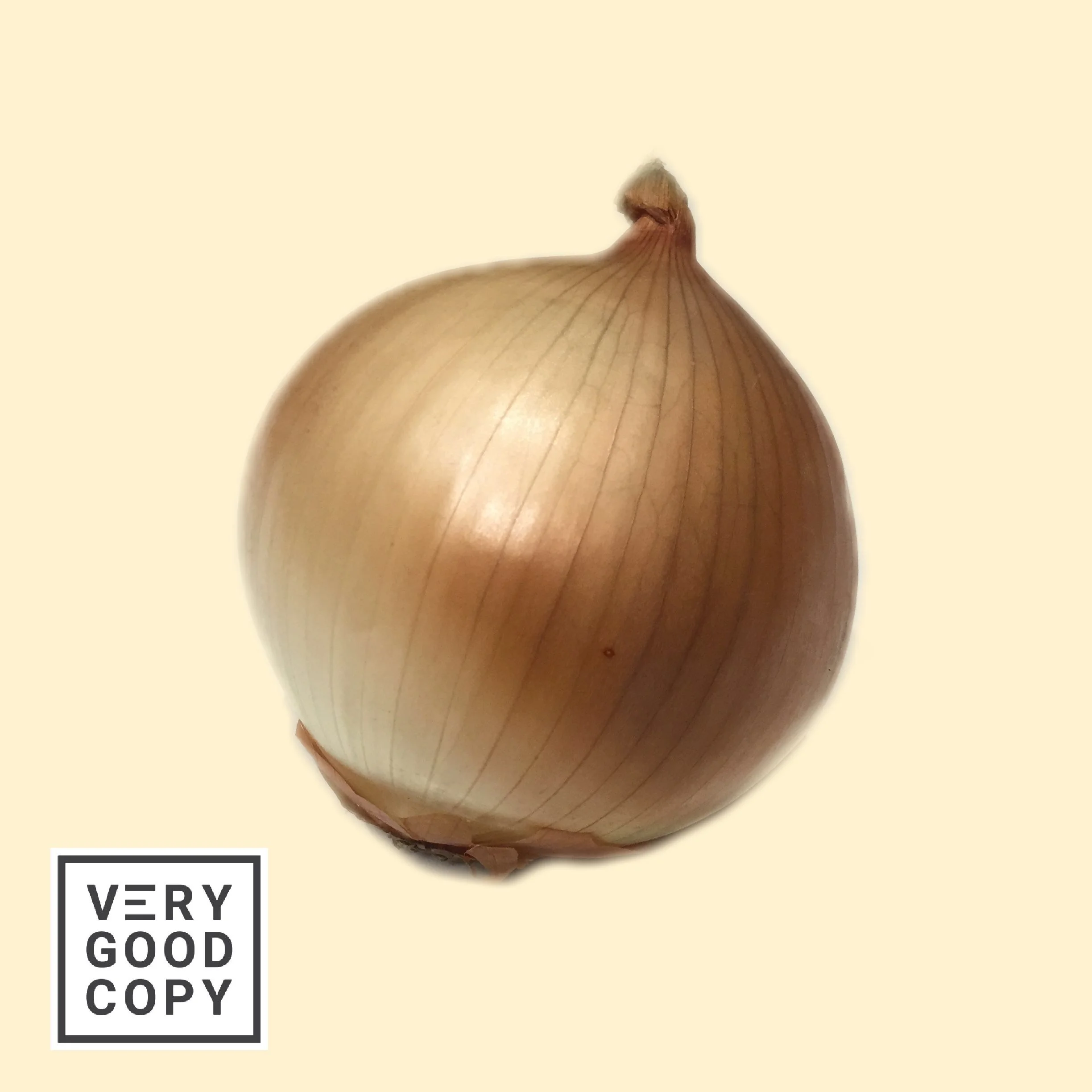
CHICAGO—Saying he was ‘more than happy’ to jump on the call, Scott Dikkers, The Onion’s longest-serving editor-in-chief, graciously gave time out of his day to talk to a copywriter about how to overcome writer’s block.

As a copywriter, it’s tempting to get lost in the majesty of your creativity, your ideas.

Looking inward for ideas will burn you out.
Want more ideas than you could ever use?
Confident copy says, “Go ahead, you’re making the right decision.”

Great copy starts with efficient questions.
“You have to be more concise,” he said. “You write like a water hose. You need to be a nail gun."